Link to YouTube Video: The Evolution of Protests for Racial Discrimination
All sources are linked in the description of my YouTube video.
Growing up in the age of technology and social media, I have always been surrounded by remixes of all different forms of media throughout my whole life. So many of my favorite music artists remix songs from other artists, my favorite YouTubers create parodies and reactions to other videos on YouTube, influencers all over socials are doing the same trends with their own personal touch, people are constantly editing photos, and so on. Remixing someone else’s work has always been a popular phenomenon in various forms of media, but it has become especially prevalent in today’s age with social media and the continuous rapid rise of technology, including newfound forms of editing software (Kuhn, 2012). With this new age, remixing comes in all different forms. At first I was a little confused on what a remix was because I thought it had to be some complicated, really well put together form of art, but that is not necessarily true. As I mentioned, a lot of the popular media we consume are remixes, whether we know it or not. Anything that is combining a new piece of media with another already existing piece of media, or even putting together numerous pieces of already existing media, in order to strengthen or contrast the message in that media. These messages can be very serious or very playful, it does not matter.
For this fourth hack, we were tasked with making a remix of our own. At first I was caught up on the idea of the remix being heavily edited with complicated software, but once I looked back at our class discussions, I reminded myself that this was not the case. I also wanted to make sure I built upon a message that is both prevalent and meaningful in today’s society. In order to achieve this, I decided to center my hack around protests in the United States. More specifically, I wanted to compare how protests against racial discrimination have changed from the past with the Civil Rights movement during the 1960s to the Black Lives Matter movement that took place during 2020. In order to really capture the similarities and differences between these two movements, I gathered images, audio, and video clips from various digital commons spaces and compiled them together in order to hone in on the messages that the philosophical teaching from Martin Luther King Jr. (MLK) have been lost as our protests today continue to grow more and more violent. According to Lizzie O’Shea, “the digital commons is the space where projects are worked on, where historical context allows integration with more recent initiatives. It allows people to scour the history of human endeavor to look at how problems have been solved in the past and how this thinking might usefully be applied to modern conundrums. It also facilitates the freedom for people to work in different ways, to spend varying amounts of time and energy on various elements of a particular project. The capacity to work in this way is diminished when the information commons is privatized” (O’Shea, 2019). Essentially, these spaces known as digital commons are places where people on the internet can have free access to past information for just about any topic that they may want to look into. These spaces are extremely useful when gathering information and learning about the past events. Spaces like these are the reason I was able to turn my ideas for my remix into a reality.
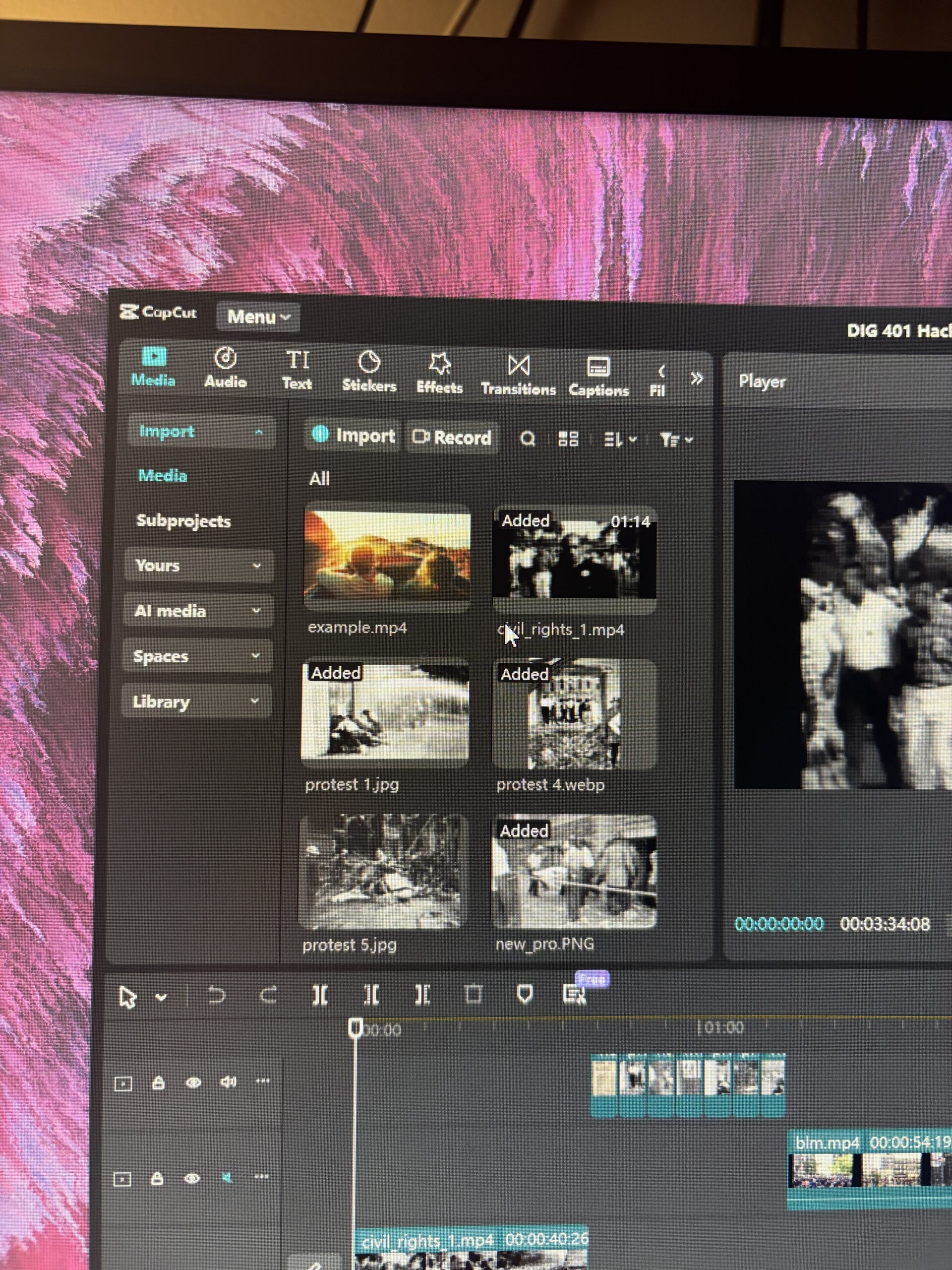
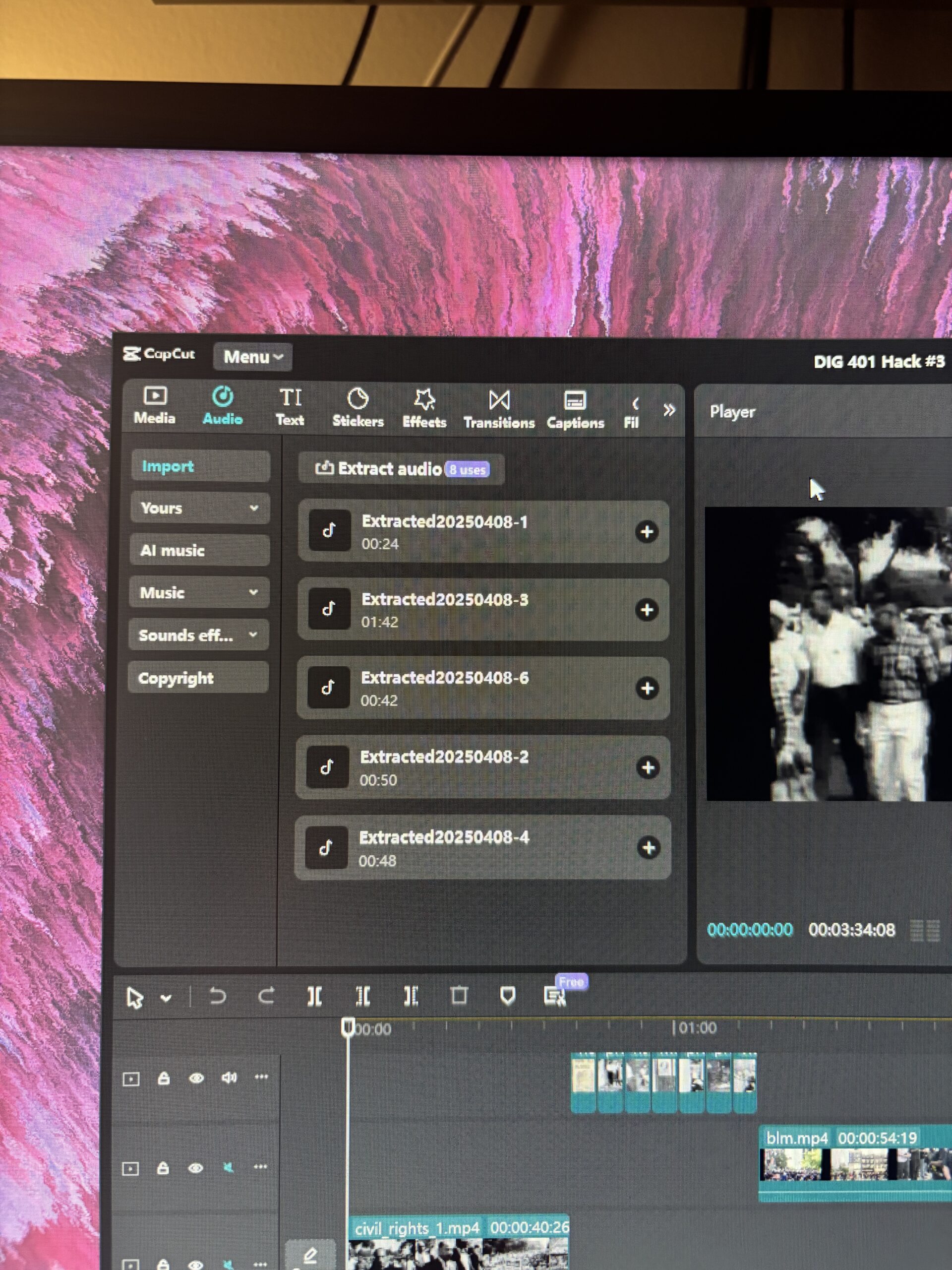
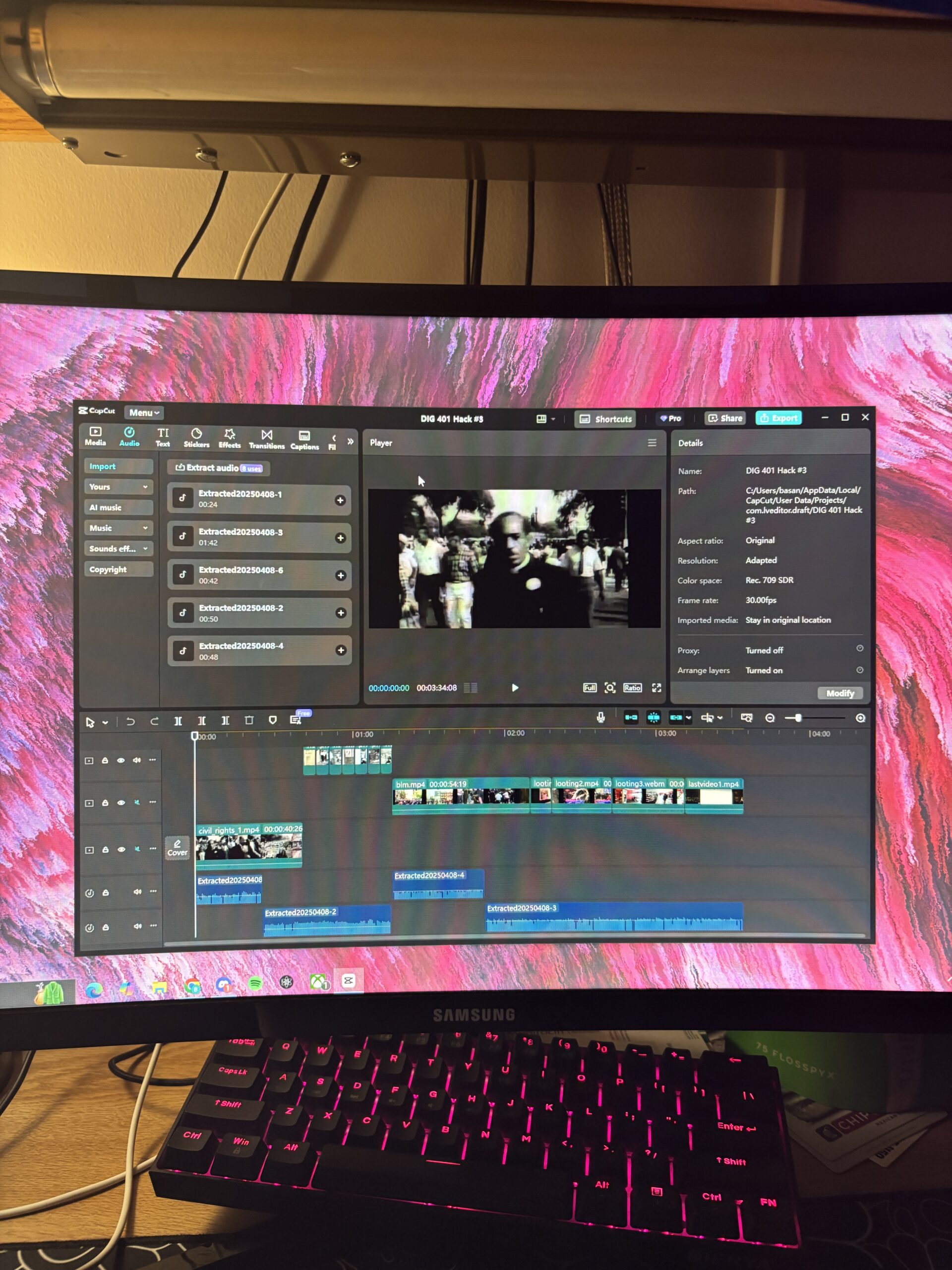
My source material for a project like this consisted of a lot of past news footage, interviews with past Civil Rights activists, actual footage of both past and present protests, etc. As I mentioned earlier, I focused on two distinct time periods for this remix; those include the Civil Rights movement and the Black Lives Matter movement. To really highlight the similarities and differences of these time periods, all the sources I gathered for this project were either from or about those two time periods. The sources that I looked at first focused more on the Civil Rights movement. First, I gathered real footage from the MLK’s march on Washington. The footage showed that peaceful protests could be successful and it displayed MLK’s true philosophy on protests. I next found an interview on YouTube with one of the activists that marched with MLK that day in Washington. In this interview, he speaks about how nonviolence and peaceful protests was the method behind the Civil Rights act. I thought this interview paired really well with the footage from the march on Washington, so I decided to extract a portion of the audio from that interview and have that play while the real footage was being displayed. This was a good way to start off my video as it captured the main ideology behind many of the protests in the 1960s. Although protests were civil a lot of the time, the police and Whites during that time were still extremely violent towards African Americans. A few weeks after MLK’s march, massive violence from the police force and Whites struck in Birmingham, Alabama as a church was bombed. I got real images of the damage and violence caused by this horrible act of violence from Wikipedia and archive.org. As these images were displayed on the screen, I played an audio clip of an interview I found on YouTube that was from two victims that were there that day in Birmingham. One of the people being interviewed spoke about how horrifying it was being a part of an incident such as that one, and the other spoke about how it was very hard to remain peaceful during that time and how many African Americans wanted to retaliate despite MLK’s method for change. I thought this was an amazing transition into the protests during 2020.
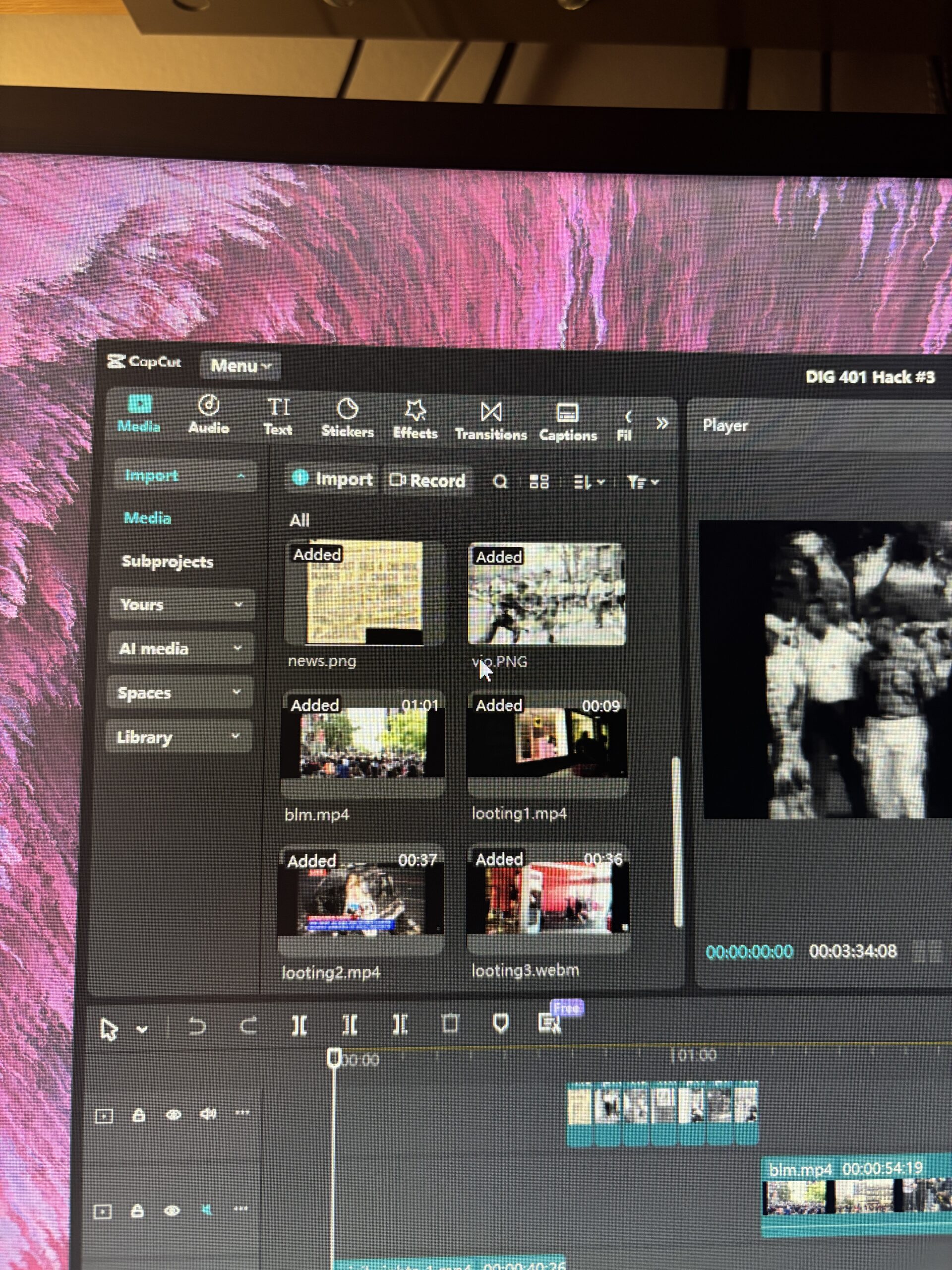
The 2020 protests were filled with lots of violence. Many individuals felt that the issues at hand were too harsh and severe to be able to just sit back and not take action, so because of this, violence struck all over the country. As time went on, it grew tougher and tougher for people during the Civil Rights movement to remain peaceful as well. At a certain point, enough was enough and violence slowly started to grow. To show this massive wave of violence due to racial injustice in the United States, I gather a bunch of video clips off YouTube from the riots, looting, and violence from the protests in 2020. For context for the viewer, I played the audio from a news broadcast from archive.org explaining what happened to start this movement. At the end of my video, I played the audio of an interview I found from a Civil Rights activist explaining the main differences between the protests during the Civil Rights movement compared to those during the Black Lives Matter movement. I felt like this was the perfect way to tie the two time periods together and really put into words what my video was trying to convey to the audience. Throughout the whole video you can see the progression from peaceful to violent protests in the United States, but then at the end, the audience is able to take a step back and think about the two different time periods together at once.
I intentionally ordered every clip in the manner that I did. I arranged them in a way where the viewer can get some historical background and also see the progression of protests, but then in the end, have the opportunity to compare the two and process the two different ideologies from different generations. I felt like it was important to bring it back to the Civil Right movement again at the end of the video because I wanted the viewers to be able to get a reflection period to have to think deeper about the message at hand. I also strategically put audio clips over video clips that way the viewer could have background context on the historical events, but also see how horrible the protests were and make them emotionally feel for the victims. I initially wanted to edit the video in a manner that was more fun and engaging, but I felt like with a topic as harsh and serious as this one, more simplistic stc editing was needed. It did not feel appropriate to add music and comedic cuts when bringing attention to a topic that had such a negative impact on so many people in the United States. I think with a message such as the one being conveyed in this video, the simpler the better. I was aiming to be straightforward and make my message very clear, and I honestly think that I accomplished this goal of mine.
When people think of protests these days, they often think of them all being extremely violent, but this was not always the case. Obviously one of my goals was to just compare protests and depict how they have changed, but the main goal of my video was to remind people that protests can be peaceful, although that can be very hard to do at times. I really do feel as though my video can bring this to the attention of all people. With so much political and governmental disagreements in the United States, I think it is of extreme importance to remind citizens of our country that we do not need to always be violated in order to provoke change.